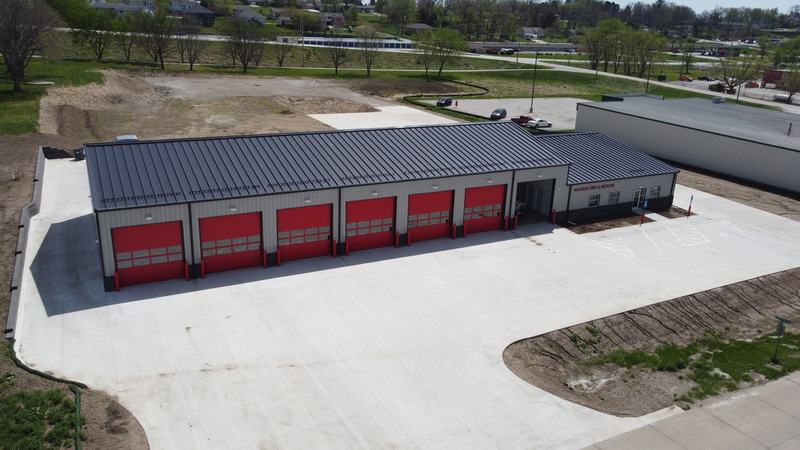

In a milestone that bridges nearly 150 years of volunteer service with a bold vision for the future, the City of Avoca has officially completed its new Avoca Fire and Rescue Station, a modern facility designed not only to meet today’s emergency response needs but to serve the community and regional area for the next century and beyond.
Now fully operational following occupancy certification on March 27, 2026, the station brings all fire and rescue equipment under one roof for the first time in the department’s history. More than a building, however, the project represents a carefully orchestrated investment in public safety, long-term planning, and fiscal responsibility.
Years in the Making
While the new facility is now complete, the vision behind it spans more than a decade.
Local leaders and firefighters long recognized the limitations of operating out of City Hall, where both fire and EMS services were previously housed. According to Fire Chief Drew Becker, conversations about a new facility began as early as 2009, marking more than 15 years of planning, evaluation, and persistence.
That vision became reality on April 21, 2025, when city officials, firefighters, and community members gathered at 1313 N. Sawmill Drive to break ground on the new $3.5 million Public Safety Station. Construction began shortly thereafter, with a clear goal: deliver a modern, fully equipped facility capable of supporting Avoca’s growing emergency service needs.
The project was designed to address long-standing space and operational challenges and dedicated training and meeting space; features that reflect both current demands and future growth. Today, that long-term vision has been realized.
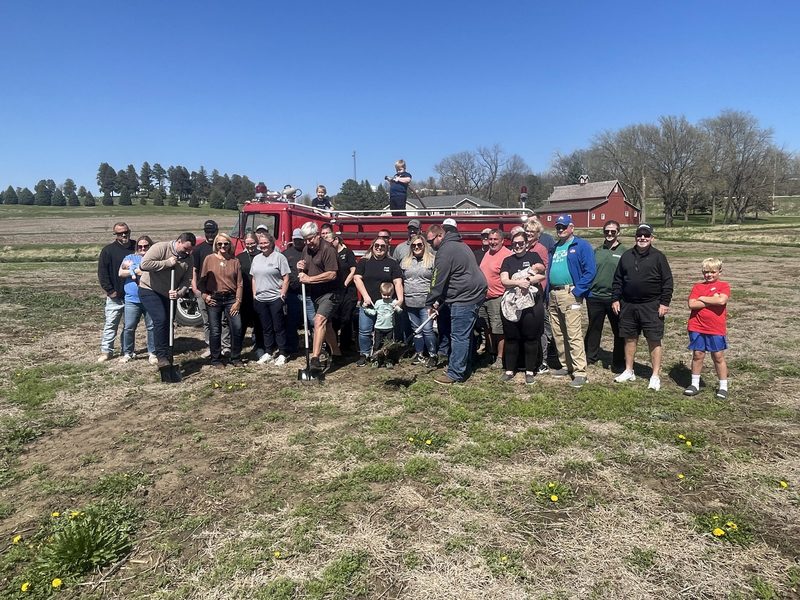 Photo of Ground Breaking, courtesy of KSOM, Western Iowa Today
Building for the Next 100 Years
City leaders approached the project with a guiding principle: build once, build right, and build for the future.
The result is a facility that enhances response times, operational coordination, and volunteer support — critical factors for a department rooted in a proud 146-year tradition of service. From improved apparatus bays to modern training and staging areas, the station ensures Avoca’s fire and rescue teams are equipped to respond efficiently across the region.
The addition of a helipad further expands emergency capabilities, positioning Avoca to better support critical care transport and regional coordination during life-threatening incidents. In rural communities — especially those located along the Interstate 80 corridor — where minutes can make the difference, this infrastructure represents a meaningful advancement in lifesaving capacity.
“It’s a great site with a large enough area to hold training, and our designated helipad area will allow a helicopter to land if necessary,” said Fire Chief Drew Becker. “We built for the future. It’s exciting! The process was long, but I think everybody is excited and ready for it.”
The station was intentionally designed to meet both immediate and long-term needs, including multiple apparatus bays, dedicated sleeping quarters for overnight response readiness, a storm-safe room, and a flexible meeting and training space. These features not only improve daily operations but also ensure the department is prepared to serve a growing region for decades to come.
Smart Design Meets Long-Term Efficiency
Beyond functionality, the building reflects forward-thinking design and operational sustainability.
The facility incorporates:
Energy-efficient mechanical, electrical, and HVAC systems
LED lighting throughout
Enhanced insulation standards
Hydronic radiant floor heating in apparatus bays for efficient winter operations
These features are not just modern conveniences; they are strategic investments aimed at reducing long-term operating costs and preserving taxpayer resources over the life of the building.
Financing the Future: Strategic Investment Without Shifting the Burden
Perhaps most notable is not just the facility itself, but how it was financed.
While the new Avoca Fire and Rescue Station stands as a visible investment in public safety, the funding strategy was intentionally designed to protect taxpayers while positioning the community for long-term success.
To construct the facility, the City issued General Obligation (GO) Bonds, a widely used and secure municipal financing tool backed by the City’s full faith and credit. These bonds allow the City to fund major infrastructure upfront and repay the cost over time, spreading the investment across the facility’s useful life rather than placing the burden on a single generation of taxpayers. In Avoca’s case, the bonds will be repaid over a 20-year period.
Rather than relying on increases in property taxes, the City structured a layered financing model that leverages Tax Increment Financing (TIF) and Franchise Fee revenues to cover the majority of the debt service. This approach builds upon earlier planning efforts, including the implementation of a franchise fee to provide stability and offset potential fluctuations in TIF revenue.
Capturing Growth to Fund Progress
At the core of this strategy is TIF, a financing tool that allows the City to capture the increase in property tax revenue generated within designated urban renewal areas.
When property values rise due to new development or reinvestment, that incremental growth in tax revenue is redirected to pay for public improvements that helped make that growth possible in the first place.
Importantly, this is not a new tax! It is growth that would not exist “but for” the investment.
In Avoca’s case:
Increased property valuations within TIF districts generate new revenue
That revenue is applied directly to annual bond payments
Responsibility is aligned with development and expansion — not existing taxpayers
Additionally, TIF captures growth from multiple taxing entities, including the County, Community College, and School District, maximizing the value of new development.
Protecting the General Fund
To ensure essential services remain stable, the City implemented a Franchise Fee on gas and electric utilities, authorized under Iowa law, creating a dedicated revenue stream to support operations.
This approach:
Offsets General Fund impacts from TIF
Maintains service levels without reductions
Provides long-term financial flexibility
A “Pay-As-You-Grow” Model
Together, these tools create a “pay-as-you-grow” model:
GO Bonds fund the project upfront
TIF captures new growth to repay the debt
Franchise Fees stabilize the General Fund
This structure allows Avoca to invest in critical infrastructure today while aligning repayment with future growth — not shifting costs onto current residents.
Transparency, Iowa Law, and Public Process
The financing plan was developed through a transparent and accountable public process, including required public hearings, published notices, and full compliance with Iowa law.
Under Iowa Code Chapter 384, construction of a fire and rescue facility qualifies as an “essential corporate purpose.” As a result, the City is authorized to proceed through a public hearing and council approval process rather than a mandatory referendum.
At the same time, Iowa law preserves public oversight: residents retain the right to file a petition within a prescribed timeframe to require a public vote on the bonds. No public objections or comments were received.
The project followed a clear and open timeline:
Initial concepts reviewed on December 11, 2024 with SEH, Inc.
Public hearings held on March 6 and March 31, 2025
Resolutions were formally approved on those same dates
Groundbreaking held April 21, 2025, with construction beginning shortly after
Occupancy was achieved March 27, 2026
These steps ensured residents had opportunities to review, ask questions, and engage throughout the process.
Rooted in History, Rising Toward the Future
The opening of Avoca’s new Fire and Rescue Station is not simply a step forward—it is a continuation of a legacy nearly 150 years in the making.
From the construction of an 800-barrel cistern in 1879 to the formation of the “Red Jackets” in 1880, Avoca has long demonstrated a commitment to protecting its residents. The 1897 fire hall served as both an operational center and a community gathering place, while the 1966 facility, now City Hall, reflected continued investment supported by local donations.
Today’s station on Sawmill Drive carries that legacy forward.
From a hand-pulled hose cart to a modern emergency response facility with a helipad, the evolution of Avoca’s fire service tells a story of a community that plans ahead, invests wisely, and never loses sight of what matters most.
A Community Milestone Worth Celebrating
To mark the occasion, the City invites residents and regional partners to celebrate together during a community celebration at 1313 N. Sawmill Drive on Saturday, May 9, 2026:
Open House: 11:00 AM – 2:00 PM
Hose Uncoupling Ceremony: 11:30 AM
The celebration continues at S. Elm St. between W. High St. & Lyon St. during the Street Dance Fundraiser from 6:00 PM – 10:00 PM with food trucks, entertainment, and beverages.
This is an opportunity to tour the facility, recognize the efforts of those involved, and celebrate this milestone together as a community, officially welcoming a new era of fire safety, emergency response services, and pride for the City of Avoca.
More Than a Building
In the end, the Avoca Fire and Rescue Station stands as more than a structure of steel and concrete.
It is a symbol of forward-thinking leadership. A commitment to those who serve. And a promise to the community — that even in a small town, big vision, smart planning, and shared purpose can shape a safer, stronger future.
What was once a ceremonial groundbreaking just over a year ago has now become a fully realized investment in Avoca’s future.